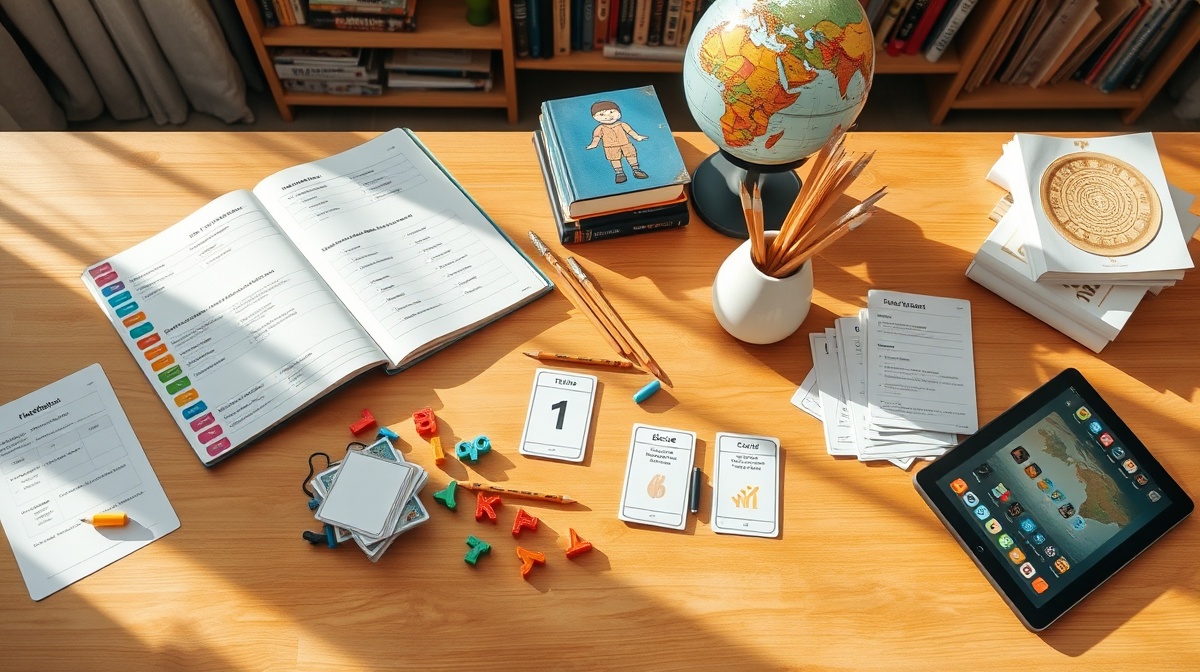
I spent three weeks comparing 47 different math programs before my first year of homeschooling. I made spreadsheets. I watched YouTube reviews until my eyes burned. I even joined Facebook groups where parents argued passionately about phonics approaches like it was politics.
Here's what I wish someone had told me: Choosing the right homeschool curriculum doesn't have to be this hard—and it's actually the single most important decision you'll make as a homeschooling parent.
Look, I get the anxiety. There are thousands of curriculum options out there, conflicting reviews from other parents, tight budgets, and the overwhelming pressure to get it "right" for your child's unique learning style. Add in the fact that most of us are figuring this out as we go, and it's no wonder new homeschoolers freeze up in the curriculum aisle.
But here's the thing—by the end of this guide, you'll know exactly how to navigate curriculum options and build a personalized plan that actually works for your family. I'm covering everything from preschool through high school with actionable frameworks that cut through the noise and get you to the good stuff.
Ready? Let's fix your curriculum overwhelm once and for all.
What Curriculum Should I Choose for Homeschooling?
The honest answer? There's no one "best" curriculum floating out there waiting to be discovered. I know that's not what you want to hear, but stick with me—this is actually good news.
The right curriculum for your family depends on three core factors that most curriculum reviews completely ignore:
Your teaching style: Are you someone who thrives with a detailed lesson plan laid out for you, or do you prefer winging it based on your child's interests that day? Do you love traditional workbooks, or does the thought of endless worksheets make you want to run?
Your child's learning style: Is your kid a visual learner who needs colorful diagrams and charts? An auditory learner who absorbs information through stories and discussions? A kinesthetic learner who needs to move and touch to understand concepts?
Your family's values and goals: Are you focused on college prep from day one? Do you want faith-based materials? Are life skills and practical learning more important to you than academic benchmarks?
Here's what I've learned after years of trial and error: curriculum fit matters more than curriculum quality. A top-rated math program that works beautifully for structured learners might frustrate a hands-on, kinesthetic kid to tears. And that's not the program's fault—or your child's fault. It's just not the right fit.
Before you buy anything, ask yourself these five questions:
- How much time do I realistically have to prepare lessons each week?
- Do I want everything laid out for me, or do I prefer mixing and matching?
- What's my actual budget per subject? (Be brutally honest here)
- Does my child need more structure or more flexibility to thrive?
- Are there any non-negotiables for our family (faith-based, secular, specific teaching methods)?
Your answers will eliminate about 80% of your options right off the bat. And that's exactly what you want.

The Three Major Curriculum Philosophies (And Which One Might Be Right for You)
Let me break down the three main approaches to homeschool curriculum. Most families end up being a mix of these, but understanding the philosophies will help you figure out your starting point.
Traditional/School-at-Home Approach
This is what it sounds like—textbooks, workbooks, structured lessons that mimic what happens in conventional schools. Think grade-level expectations, regular testing, and clear scope and sequence charts.
Best for: Families transitioning from public school, structured learners who thrive with routine, parents focused on college prep, and honestly, parents who need the confidence that comes with clear benchmarks.
Examples you'll see everywhere: Saxon Math, Abeka, IEW (Institute for Excellence in Writing), and most "complete" boxed curricula.
My take: This approach gives parents clear benchmarks and takes the guesswork out of "Am I covering enough?" But it can feel rigid for creative kids, and you'll spend more money upfront since everything's pre-planned.
Charlotte Mason Method
This philosophy centers around "living books" (real literature instead of textbooks), shorter lessons, nature study, and character development. The idea is that children learn best through relationships with great ideas and beautiful language.
Best for: All ages honestly, families who love reading together, kids who get bored with traditional textbooks, and parents who want education to feel more holistic and less compartmentalized.
Examples: Ambleside Online (free!), Simply Charlotte Mason, and lots of DIY approaches using library books and nature journals.
Real insight: My daughter's love of reading absolutely exploded when we switched to this approach. But fair warning—it requires parents to source materials and be comfortable without traditional "grades" or assessments.
Unschooling/Child-Led Learning
This is the most hands-off approach. Kids learn through their natural interests and everyday life experiences. No formal curriculum, no grade levels, no required subjects beyond what your state mandates.
Best for: Self-motivated learners, families with flexible schedules, kids who learn better through projects and real-world applications, and parents who are comfortable trusting the process.
Honest take: This requires the most parental confidence and works best with older kids who can self-direct their learning. It's not "no school"—it's learning that looks completely different from traditional education.
How Do I Plan a Homeschool Curriculum?
Alright, let's get practical. Here's my step-by-step process for planning a homeschool curriculum that actually works (and doesn't break the bank).
Step 1: Assess Your Starting Point
If you're transitioning from public school, start by reviewing what your child has already covered. Request their records, look at their report cards, and honestly assess where the gaps might be. Don't assume they've mastered everything just because they got good grades—sometimes kids slide by without truly understanding concepts.
If you're starting fresh with a younger child, use grade-level benchmarks as a reference point, not a mandate. Your five-year-old doesn't have to read by kindergarten just because the standards say so.
Create a simple spreadsheet with subjects and your child's current level. This becomes your roadmap.
Step 2: Define Your Non-Negotiables
What subjects are absolutely mandatory? Usually that's math, language arts, science, and social studies, but check your state requirements to be sure.
What are your educational values? Do you want classical education with Latin and logic? STEM-focused learning? Nature-based education? Faith-based materials? Secular approaches only?
What's your realistic budget? I'm talking about the amount you can spend without stress, not the amount you could theoretically scrape together. This single decision will eliminate tons of options and reduce your decision fatigue dramatically.
Step 3: Research and Sample Before Buying
Here's where most people go wrong—they buy based on reviews and recommendations without actually seeing if the materials work for their specific kid.
Most publishers offer free samples, trial periods, or preview videos. Use them. Join homeschool Facebook groups and ask for honest reviews from people who are using the curriculum right now, not people who used it three years ago.
And please, don't buy based on Instagram aesthetics alone. Those beautiful flat lay photos don't tell you if the program actually teaches math effectively.
Step 4: Create a Realistic Schedule
Most homeschoolers spend 2-4 hours per day on core subjects, depending on age. Here's a sample breakdown that works for many elementary families:
- Math: 45 minutes
- Language Arts: 60 minutes (reading + writing combined)
- Science: 30 minutes
- History: 30 minutes
- Electives/free play: 60+ minutes
Your schedule will evolve throughout the year. Build in flexibility for field trips, sick days, and those amazing learning tangents that happen when your kid gets fascinated by something unexpected.
Step 5: Plan for Flexibility and Adjustments
Here's something no one tells new homeschoolers: it's completely normal to switch curricula mid-year if something isn't working. You're not failing—you're adapting.
Set a check-in point at the end of your first quarter to evaluate what's working and what isn't. Some red flags to watch for: daily battles over a subject, your child regressing instead of progressing, or you dreading certain lessons.
Homeschool Curriculum Ideas by Grade Level
Early Childhood (Preschool & Kindergarten)
Honestly, at this age, your best curriculum is a library card and daily nature walks. I'm not being flippant—research shows that play-based learning is far more effective for young children than formal academics.
That said, if you want some structure, Charlotte Mason and gentle unschooling approaches work beautifully here. Focus on letter recognition, phonics foundations, numbers 1-10, fine motor skills, and social-emotional learning.
Specific curriculum ideas:
- Sonlight Preschool: Literature-based with parent-guided activities
- All About Reading Pre-reading: Gentle phonics foundations
- Handwriting Without Tears: Excellent for fine motor development
Create a simple rhythm rather than a rigid schedule. Think 15-20 minute lessons with lots of play, hands-on activities, and read-alouds. If your child resists formal learning, back off. There's no academic emergency at age four.
Elementary (Grades 1-3)
This is the sweet spot for building strong foundations while maintaining joy in learning. You want a mix of structured academics (especially for math and phonics) with creative, engaging approaches to science and history.
Core subjects breakdown:
Math: Saxon Math K-3 for structured learners, Singapore Math for conceptual thinkers, or Beast Academy for kids who love puzzles and creative problem-solving.
Language Arts: All About Reading for systematic phonics, IEW Writing With Ease for gentle writing instruction, plus tons of read-alouds and library books.
Science: Evan-Moor Science for easy prep, Elemental Science for more depth, or just explore nature and do simple experiments.
History: Story of the World Volume 1 with activity guides, Curiosity Chronicles for a gentler approach, or create your own unit studies around time periods that interest your child.
This is the perfect age for a hybrid approach—structure in math and phonics where kids need solid foundations, creativity and exploration in history and science where engagement matters most.
Upper Elementary (Grades 4-6)
Now you can start shifting toward more student-directed learning and project-based options. Kids this age can handle deeper dives into their interests while still building essential skills.
Curriculum ideas:
Math: Continue with Saxon or Singapore, or try Art of Problem Solving for mathematically gifted learners who need more challenge.
Language Arts: Transition from Writing With Ease to Bravewriter for more creative writing, add literature-based reading programs, or start family book clubs.
Science: Elemental Science for thorough coverage, hands-on experiment books like Steve Spangler Science, or let kids choose topics for independent research projects.
History: Story of the World Volume 2, unit studies that combine history with geography and literature, or timeline projects that let kids see connections across time periods.
This is when you can really customize based on interests. Add electives like coding, art, music, or foreign languages. One major project or unit study per quarter helps deepen learning and keeps things engaging.
Middle School (Grades 7-8)
Middle school is all about preparing for independence while managing the social and emotional changes happening at this age. Kids need more responsibility for their own learning, plus opportunities for critical thinking and real-world applications.
Curriculum ideas:
Math: Pre-algebra and Algebra I (Art of Problem Solving for advanced learners, Teaching Textbooks for independent study, or Saxon for traditional approach)
Language Arts: Great books paired with essay writing instruction (IEW, Bravewriter, or Writing With Ease), plus independent reading in genres that interest them
Science: Real lab-based courses become important here—Elemental Science, Apologia, or online options like Khan Academy
History: Story of the World Volume 3, primary source analysis, debate projects, or current events discussions
Here's the thing about middle school: this is when many homeschoolers benefit from adding outside classes or co-ops for social connection. Your child might be ready for more independence, but they also need peer interaction and different teaching styles.
Start thinking about high school transcript requirements now, even if graduation feels far away.
High School (Grades 9-12)
High school homeschooling is a different beast entirely. You're dealing with college prep, transcript building, and increasing academic rigor. The stakes feel higher because they kind of are.
Major considerations: Credit requirements, accreditation options, transcript documentation, and preparing for standardized tests if college is the goal.
Curriculum ideas:
Math: Algebra I → Geometry → Algebra II → Pre-Calculus/Statistics (Art of Problem Solving, Teaching Textbooks, or online options like Khan Academy)
Language Arts: Literature-based approaches with serious writing instruction (IEW, Bravewriter Advanced, or dual enrollment classes)
Science: Lab-based courses become crucial (Apologia, online programs with lab kits, or community college courses)
History: World History, U.S. History, Government, Economics (Great Courses, online options, or traditional textbooks)
Many high school homeschoolers do a mix of home study, online classes, dual enrollment at community colleges, and outside tutoring for challenging subjects. Don't feel like you have to teach everything yourself—high school is about preparing your teen for independence.

Final Thoughts: Trust the Process (And Yourself)
After years of homeschooling and talking with hundreds of other homeschool families, here's what I want you to remember: perfect curriculum doesn't exist, but the right curriculum for your family absolutely does.
You're going to make mistakes. You'll buy programs that don't work, try approaches that flop, and have days when you question everything. That's not failure—that's learning what works for your unique child.
Start with one core curriculum that feels manageable, add subjects gradually, and adjust as you go. Your homeschool will evolve every year, and that's exactly how it should be.
Most importantly, trust yourself. You know your child better than any curriculum publisher, education expert, or well-meaning relative. When you combine that knowledge with quality materials and a willingness to adapt, you can't go wrong.
Your homeschool curriculum doesn't have to be perfect from day one. It just has to be a good starting point for the amazing educational journey you're creating together.