
The Day I Threw Out Our Math Textbook
Picture this: It's 10 AM on a Tuesday, and I'm watching my 8-year-old daughter stare blankly at page 47 of her math workbook. Again. She's fidgeting, sighing, and asking for the third time if she can "please just do something else." Meanwhile, my 6-year-old is building elaborate dinosaur habitats with blocks, completely absorbed and learning more about spatial reasoning than any worksheet could teach.
That's when it hit me. Why was I forcing disconnected subjects when kids naturally learn through exploration and play?
I discovered unit studies that afternoon, and honestly? It changed everything. Instead of juggling separate textbooks for math, science, reading, and history, we started diving deep into themes my kids actually cared about. Suddenly, learning felt natural again.
If you're a creative parent feeling overwhelmed by traditional homeschool approaches, I've got good news. Unit studies aren't harder than textbook teaching—they're actually easier and way more joyful. I'm going to share 15 engaging themes that work beautifully for elementary ages, plus exactly how to build your own.
Trust me, your kids (and your sanity) will thank you.
What Are Unit Studies in Homeschooling?
Unit studies flip traditional education on its head. Instead of teaching math at 9 AM, science at 10 AM, and history at 11 AM, you pick one fascinating topic and weave all your subjects around it.
Think of it like this: traditional textbook learning is like eating a compartmentalized TV dinner. Unit studies? That's a home-cooked meal where all the flavors blend together perfectly.
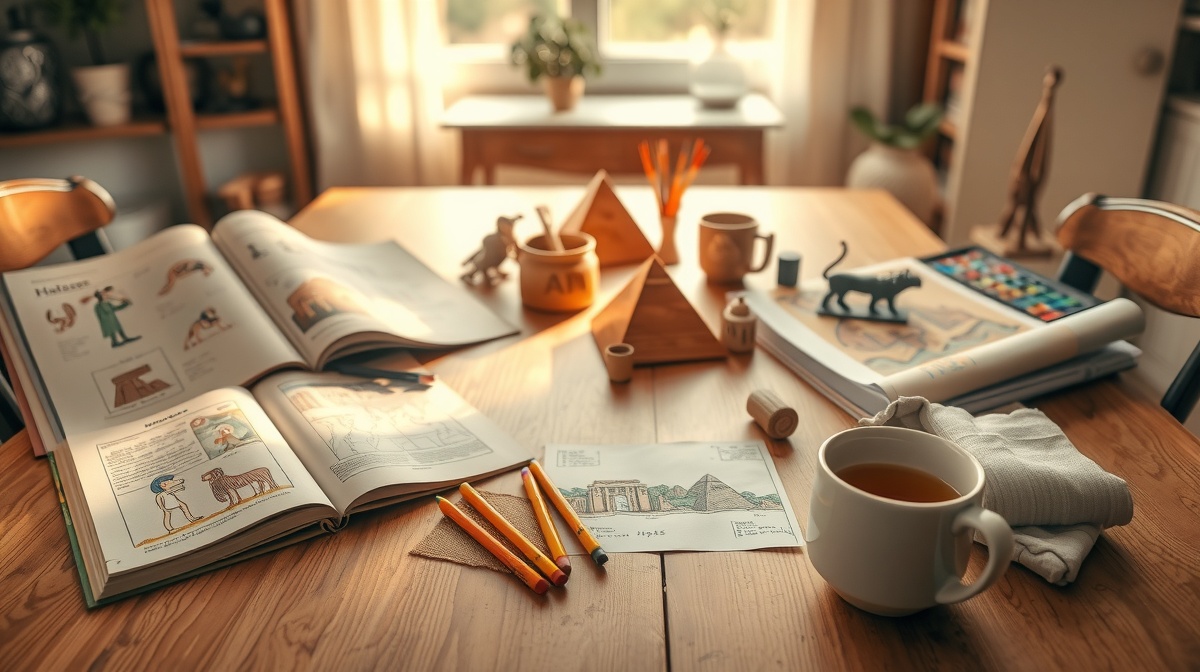
Here's a real example from our homeschool. When we studied Ancient Egypt, we weren't just memorizing pharaoh names. We read Egyptian myths (literature), calculated pyramid dimensions (math), explored the Nile River on maps (geography), learned about mummification (science), created hieroglyphic art projects (art), and wrote our own adventure stories set in ancient tombs (creative writing).
Everything connected. Everything made sense.
For creative parents, unit studies are a dream. You can customize everything to your family's interests and learning styles. Your outdoor-loving kid can study ecosystems by actually exploring your backyard. Your artsy child can learn history through hands-on crafts and storytelling.
The best part? Unit studies actually reduce prep time once you understand the method. Instead of planning six different subjects, you're planning one cohesive theme that naturally covers multiple learning areas.
How Do I Create a Unit Study for My Child?
Creating your first unit study feels overwhelming until you break it into simple steps. I've walked dozens of homeschool families through this process, and the magic happens when you start with genuine interest, not what you think you "should" teach.
Step 1 — Pick a Topic Your Child Is Obsessed With
The best unit studies start with something your child already loves talking about. Seriously. If your kid will ramble about sharks for 30 minutes unprompted, you've found your theme.
I've seen incredible unit studies built around the weirdest interests: medieval castles, garbage trucks, butterflies, volcanoes, even pizza. The topic matters less than the enthusiasm behind it.
Here's my quick test: mention the topic and watch your child's face. Do their eyes light up? Do they immediately start sharing facts or asking questions? That's your green light.
Step 2 — Map Out the Subject Connections
This step intimidates new unit study parents, but it's actually fun once you get the hang of it. Take your chosen topic and brainstorm how different subjects naturally connect.
Let's say your child picked "Ocean Exploration." Here's how subjects might weave in:
- Science: Ocean zones, marine life, ecosystems
- Math: Measuring ocean depths, comparing whale sizes
- Reading: Ocean adventure books, research articles
- Writing: Ocean journal, creative stories about sea creatures
- Geography: World's oceans, underwater mountain ranges
- Art: Ocean creature drawings, watercolor seascapes
Don't force every subject into every unit study. If art doesn't naturally fit your space theme, skip it. You'll cover art in your next unit study about famous painters.
Step 3 — Gather Resources (Without Drowning in Pinterest)
Resource gathering can become a rabbit hole if you're not careful. I used to spend hours pinning elaborate unit study ideas I'd never actually use.
Here's my streamlined approach:
- Library books: Check out 8-10 books on your topic (mix of picture books, chapter books, and reference materials)
- Documentaries: Search YouTube or your streaming service for age-appropriate videos
- Hands-on supplies: Keep it simple—basic craft materials, science experiment ingredients, maps or globes
- Websites: Find 2-3 reliable educational sites for deeper research
Pro tip: Pre-built unit study curricula can save massive amounts of time here. Companies like Amanda Bennett, KONOS, and Moving Beyond the Page have done the resource-gathering legwork for you. Not everyone needs to reinvent the wheel.
Step 4 — Create a Simple Timeline
Most elementary unit studies work beautifully over 2-6 weeks. Longer than that, and even the most interested kids start losing steam.
I like to plan loosely by week:
- Week 1: Introduction and broad overview
- Week 2: Deep dive into most interesting aspects
- Week 3: Hands-on projects and experiments
- Week 4: Creative culmination (presentations, field trips, special projects)
Keep your daily structure flexible. Some days you might spend 20 minutes on your unit study. Other days, when curiosity is running high, you might spend the entire morning exploring your theme.
Why Unit Studies Are Perfect for Creative Homeschool Parents (Even If You Don't Feel Creative)
Here's what I want every homeschool parent to know: you don't need to be a Pinterest perfectionist to rock unit studies.
I'm not naturally crafty. My bulletin boards look like a kindergartner decorated them. But unit studies let me play to my actual strengths—storytelling, asking good questions, and getting excited about learning alongside my kids.
The real benefits go way beyond pretty homeschool photos:
- Flexibility: Spend extra time on what fascinates your child, skip what doesn't click
- Less burnout: Planning one cohesive theme beats juggling six separate subjects
- Better retention: Kids remember connected learning far longer than isolated facts
- Multi-age friendly: Siblings can study the same theme at different complexity levels
Last year, our "Inventions" unit study looked pretty messy from the outside. We had cardboard contraptions scattered across the living room, failed experiments on the kitchen counter, and library books stacked everywhere. But my kids learned more about problem-solving, perseverance, and scientific thinking than any pristine worksheet could have taught them.
Unit studies work whether you're the outdoorsy parent who loves nature hikes, the bookworm who devours historical fiction, or the hands-on parent who enjoys cooking and building projects. The theme becomes your canvas—you get to paint it with your family's unique colors.

The 15 Unit Study Themes That Actually Engage Elementary Kids
These themes work across elementary ages because they tap into kids' natural curiosity and wonder. I've tested most of these with multiple families, and they consistently create those magical "I don't want to stop learning" moments.
Themes 1-5: Adventure & Exploration
Ocean Exploration: Dive into marine ecosystems, underwater geography, and sea creature adaptations. Connect through marine biology (science), ocean depth measurements (math), adventure stories (reading), and underwater art projects. Try creating your own "deep sea research station" in the living room.
Rainforest Survival: Explore layers of rainforest ecosystems, indigenous cultures, and conservation efforts. Perfect for geography, environmental science, cultural studies, and creative writing. Build a cardboard canopy and study which animals live at each level.
Space & Astronomy: From our solar system to black holes, space themes never get old. Natural connections to physics, measurement, mythology (constellation stories), and futuristic creative writing. Track moon phases for a month or calculate your weight on different planets.
Ancient Civilizations: Egypt, Rome, Greece, or Maya—each offers rich connections to history, geography, art, architecture, and daily life comparisons. Create timeline projects, build model structures, or write stories from a child's perspective in ancient times.
Dinosaurs & Paleontology: More than just naming dinosaur species—explore fossilization, geological time periods, scientific discovery methods, and extinction theories. Connect through measurement (dinosaur sizes), creative writing (time travel stories), and archaeological dig simulations.
Themes 6-10: Creativity & Making
Inventions & Inventors: Study famous inventors while encouraging original problem-solving. Perfect for engineering design process, biography reading, patent research, and prototype building. Challenge kids to invent solutions to family problems.
Architecture & Design: Explore building styles across cultures and time periods. Natural connections to geometry, engineering, cultural studies, and artistic design. Build model structures and test their stability.
Cooking Around the World: Geography, cultural studies, measurement, following directions, and nutrition all blend beautifully. Each week, "visit" a different country through its cuisine while learning about climate, agriculture, and traditions.
Art History & Famous Artists: Study artistic movements while creating original artwork in different styles. Connects to history, cultural studies, color theory, and creative expression. Try recreating famous paintings with your own twist.
Music & Instruments: Explore how different cultures create music, physics of sound waves, mathematical patterns in music, and historical context of musical periods. Make simple instruments and compose original songs.
Themes 11-15: Nature & Living Things
Ecosystems & Habitats: Choose local ecosystems or exotic ones like tundra or desert. Study interdependence, food webs, adaptation, and conservation. Create habitat dioramas or adopt a local ecosystem to observe throughout the year.
Insects & Bugs: Perfect for reluctant science learners—bugs are fascinating once you really look. Explore life cycles, classification, beneficial vs. harmful insects, and insect-inspired engineering. Start a bug observation journal.
Human Body & Health: From skeletal system to nutrition, this theme connects biology, health education, measurement, and personal wellness. Create body system models or track family health habits.
Plants & Gardening: Botany, life cycles, photosynthesis, nutrition, and environmental science all grow together naturally. Start seeds, create plant life cycle wheels, or design an ideal garden layout.
Animals & Conservation: Focus on animal adaptations, habitats, endangered species, and human impact on wildlife. Perfect for research skills, persuasive writing about conservation, and habitat studies.
One Complete Unit Study Example: How I Built Our "Ocean Exploration" Unit
Let me walk you through exactly how our ocean unit study unfolded, because seeing a real example makes everything click.
We chose ocean exploration after my youngest became obsessed with a David Attenborough documentary about deep sea creatures. For three days straight, she peppered me with questions about bioluminescence, giant squids, and why fish don't get crushed by water pressure.
Week 1: Ocean Overview
We started broad—mapping the world's five oceans, learning basic ocean zones (sunlight, twilight, midnight, abyssal), and reading picture books about marine life. Math naturally appeared when we compared ocean depths using our staircase (each step represented 1,000 feet). Writing happened through daily ocean journals where kids recorded new discoveries and questions.
Week 2: Deep Sea Creatures
This week focused on the weird and wonderful animals living at different depths. Science covered adaptation, bioluminescence, and pressure. Art projects included creating our own "deep sea creatures" with glow-in-the-dark paint. Reading involved both fiction (Magic School Bus Under the Sea) and nonfiction research about specific animals.
Week 3: Ocean Ecosystems
We studied food chains, coral reefs, and human impact on oceans. Geography expanded to include underwater mountain ranges and ocean currents. A highlight was our "coral reef" built from pool noodles where kids could identify different ecosystem relationships.
Week 4: Ocean Exploration Technology
We learned about submarines, underwater cameras, and how scientists study deep ocean areas. This naturally led to engineering challenges—could we design a waterproof container for our toys? Math involved calculating how long it takes sound to travel underwater.
Resources that worked: Library books (about 12 total), National Geographic Kids ocean videos, simple science experiments with water pressure, and basic craft supplies for creature creation.
What surprised me: My kids became genuinely excited about conservation after learning about plastic pollution. They started noticing single-use plastics everywhere and asking thoughtful questions about environmental impact.
What I'd do differently: I'd spend more time on one ecosystem (coral reefs) instead of trying to cover everything. Going deeper would have been more meaningful than covering more topics.
The Honest Truth: Common Unit Study Challenges & How to Solve Them
Let's talk about the real challenges, because unit studies aren't always sunshine and educational rainbows.
Challenge 1 — "I Don't Know Where to Start"
This paralyzes so many parents. Here's my foolproof method: spend one week just listening to your child. What do they bring up repeatedly? What makes them ask endless questions? What topics make them forget about screen time?
Start there. Not with what you think they should learn, not with what Pinterest suggests, but with their genuine curiosity.
Quick decision framework: Pick the topic that makes your child's eyes light up + has enough depth for 2-4 weeks of exploration + connects to at least 3-4 subject areas naturally.
Challenge 2 — "I'm Worried About Gaps in Learning"
I get it. When you're not following a traditional scope and sequence, the anxiety about "missing something important" can be overwhelming.
Here's the reality: thoughtfully planned unit studies actually cover more educational standards than most people realize. Your ocean unit study hits scientific method, research skills, geography, measurement, reading comprehension, creative writing, and critical thinking about environmental issues.
The key is balance. Use unit studies for about 60-70% of your learning time, then supplement with targeted skill practice where needed. Your child might need specific phonics work or math fact practice that doesn't fit neatly into thematic learning—and that's perfectly fine.
Challenge 3 — "It Takes Too Much Time to Plan"
Unit study planning can become a time monster if you're not careful. I've seen parents spend 10+ hours researching and planning each unit study, which isn't sustainable.
Time-saving strategies that actually work:
- Batch plan 3-4 unit studies during summer break
- Reuse successful themes with different children or revisit favorites
- Create simple templates for resource gathering and activity planning
- Accept that "good enough" unit studies beat perfect traditional lessons
Pre-built unit study curricula eliminate planning time entirely. Companies like Moving Beyond the Page, KONOS, and Trail Guide to Learning have done the heavy lifting—you just follow their roadmaps and customize as needed.
Challenge 4 — "My Kids Have Different Ages"
This is actually unit studies' secret superpower. The same theme works across multiple ages with different complexity levels.
During our space unit study, my 6-year-old learned planet names and basic facts while my 9-year-old calculated distances between planets and studied rocket engineering principles. Same books, same videos, same hands-on activities—just different expectations and depth levels.
Practical tips: Give older kids research and presentation responsibilities. Let younger kids focus on exploration and basic concepts. Use the same core resources but differentiate through discussion questions, writing assignments, and project complexity.

Tools & Resources That Make Unit Studies Easier
You don't need expensive materials to create amazing unit studies, but having the right resources definitely helps.
Free resources that are actually useful:
- Your local library system (including inter-library loans for specialized books)
- YouTube channels like Crash Course Kids, National Geographic Kids, and SciShow Kids
- Homeschool co-op libraries where families share unit study materials
- Museum websites with virtual tours and educational resources
Affordable tools worth the investment:
- Simple planning templates (I use a one-page overview for each unit study)
- Basic tracking sheets to record skills covered and books read
- Quality art supplies that work for multiple unit studies
- A good atlas and globe for geography connections
Pre-built curricula that save serious time:
I've used several commercial unit study programs over the years. Moving Beyond the Page offers literature-based unit studies with everything planned out. KONOS provides theme-based learning with detailed activity suggestions. Trail Guide to Learning combines unit studies with traditional skill practice.
The choice between DIY and pre-built comes down to time vs. customization. DIY unit studies perfectly match your family's interests and pace. Pre-built curricula save planning time but require more adaptation to fit your specific kids.
Even with pre-built options, you'll still customize based on your children's interests, learning styles, and available time. No curriculum works perfectly out of the box.
Budget-friendly reality check: You can run excellent unit studies with library books, basic art supplies, and creativity. Don't let resource gathering become a barrier to getting started.
How to Track Progress & Keep Records (Without the Overwhelm)
Traditional report cards don't capture the depth and breadth of unit study learning. How do you grade "discovered a passion for marine biology" or "made connections between ancient Egyptian irrigation and modern farming"?
I've tried complicated tracking systems and simple ones. Simple wins every time.
What to actually record:
- Core books read together and independently
- Major projects completed (with photos)
- Skills practiced and mastered
- Field trips and hands-on experiences
- Evidence of deeper thinking or unexpected connections
Documentation methods that work:
Photo portfolios capture learning better than test scores. Take pictures of projects, experiments, field trip moments, and kids explaining their discoveries. Add brief captions with dates and learning objectives met.
Learning journals where kids record discoveries, questions, and reflections become beautiful keepsakes and solid documentation of educational progress.
Simple checklists help ensure you're covering required subjects without getting bogged down in details. Check off "science concepts explored," "writing skills practiced," "math connections made" rather than trying to record every tiny detail.
This approach actually makes end-of-year assessment easier because you have rich evidence of real learning rather than just test scores and worksheet completion.
Unit Studies Aren't Just About Learning—They're About Rediscovering Joy
After eight years of homeschooling, I can honestly say unit studies transformed our entire educational experience. But the real magic isn't in the academic outcomes—it's in watching your children become naturally curious, self-directed learners.
When kids study topics they genuinely care about, learning stops feeling like work. They start asking deeper questions, making unexpected connections, and pursuing knowledge for the pure joy of discovery. That's the kind of learning that lasts a lifetime.
I've watched my daughter spend hours researching ocean conservation because our marine life unit study sparked genuine concern for coral reef destruction. I've seen my son teach himself advanced engineering concepts because our invention unit study got him thinking about solving real problems.
These aren't outcomes you can measure with standardized tests, but they're infinitely more valuable.
Remember, imperfect unit studies that engage your children beat perfect textbooks that bore them. Start messy. Start small. Start with whatever your child won't stop talking about.
Pick one theme from the list above and commit to trying it this month. Your kids' natural curiosity will guide you better than any curriculum manual ever could. Trust the process, trust your instincts, and watch learning come alive in your homeschool.
What topic is your child obsessed with right now? That's your first unit study waiting to happen.